
Advantech routers are highly versatile and support a wide range of applications. This chapter outlines several common deployment scenarios to illustrate the router's key features and capabilities in practical, real-world examples.
The configuration examples provided in this chapter are based on IPv4 networks.
Access to the Internet from LAN
This use case describes how to provide Internet access to a Local Area Network (LAN) using the router's cellular connection. A SIM card with an active data plan from a mobile network operator is required.
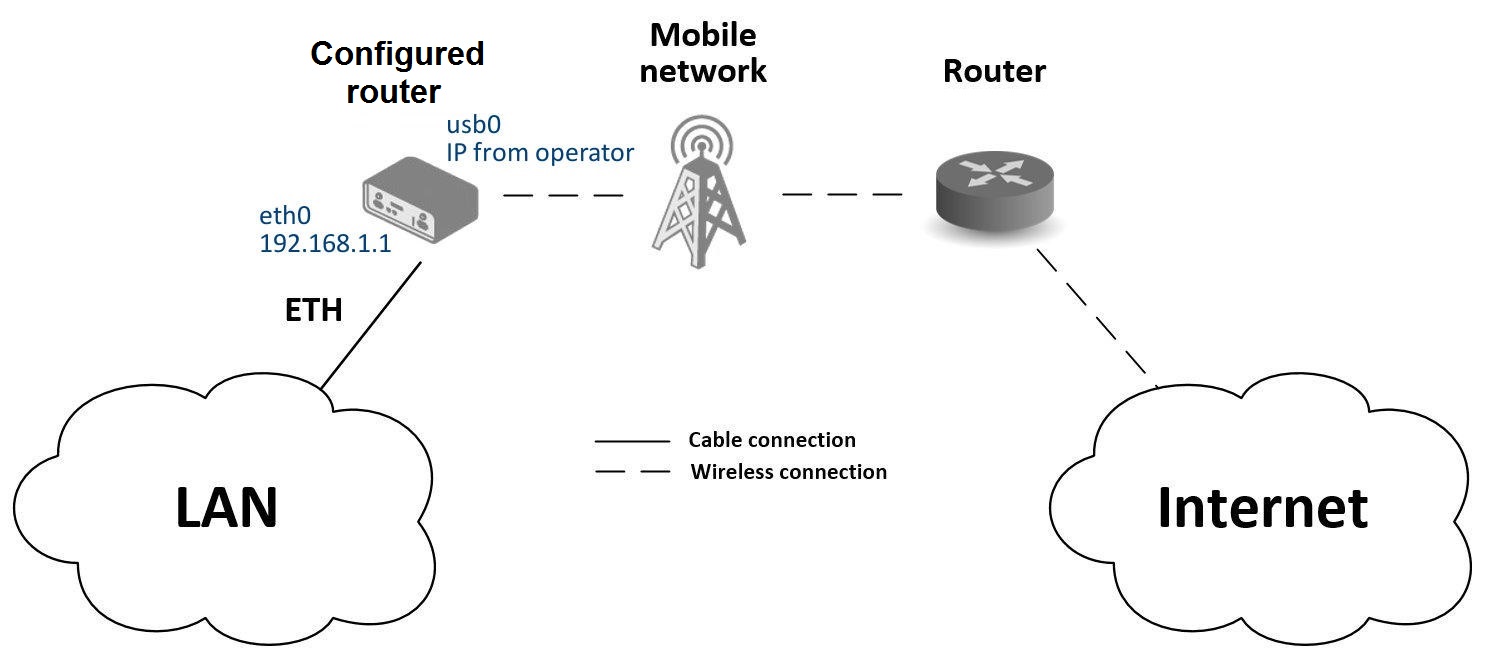
Insert the SIM card into the SIM1 slot, attach the antenna to the ANT connector, and connect the computer (or switch) to the router's eth0 interface. After powering on, wait for the router to register on the mobile network. A successful connection is indicated by the WAN and DAT LEDs on the front panel.
Additional configuration can be done in the LAN and Mobile WAN items in the Configuration section of the web interface.
LAN Configuration
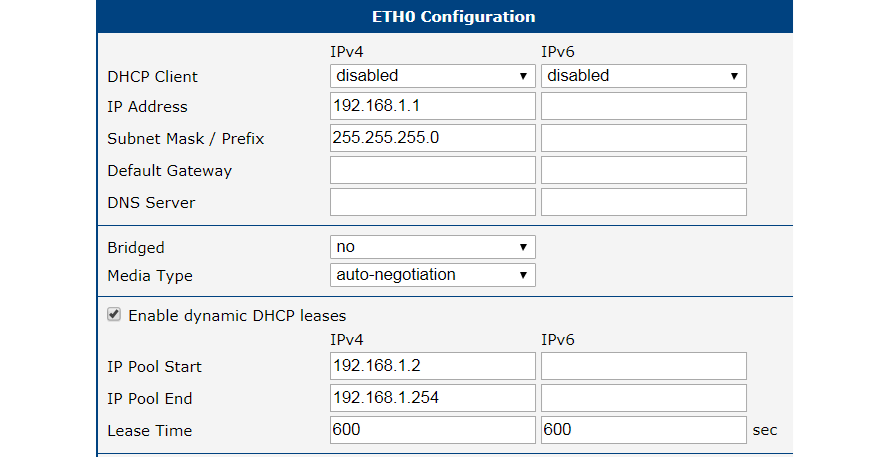
The factory default IP address of the router's eth0 interface is 192.168.1.1. To change it, navigate to the LAN item in the Configuration section. No additional configuration is required for this use case. The DHCP server is enabled by default, so the first connected device receives 192.168.1.2, and so on.
Mobile WAN Configuration
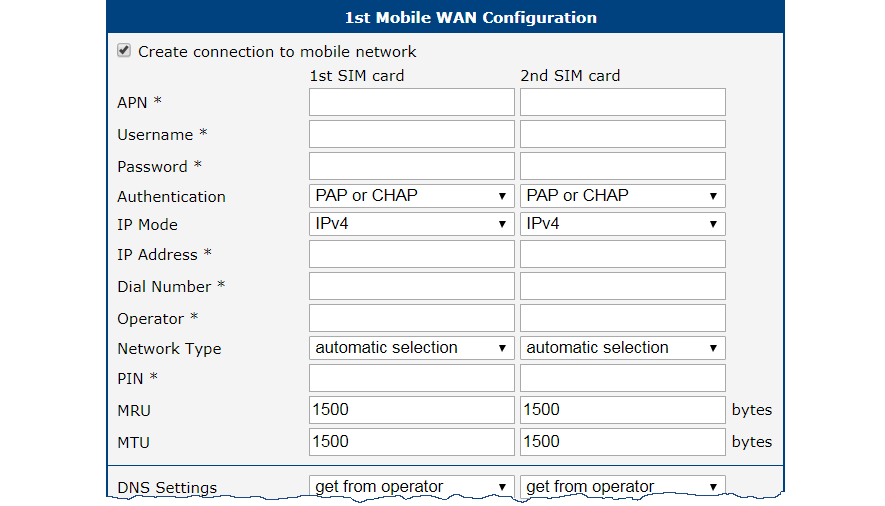
Use the Mobile WAN item in the Configuration section to configure the cellular connection. Depending on the SIM card, the configuration form can be left blank. Ensure that Create connection to mobile network is checked (the factory default).
To verify the connection, navigate to Mobile WAN in the Status section. You should see the Connection successfully established message. The Network item displays information about the newly created usb0 interface, its IP address, and the route table. The LAN now has Internet access.
Backup Access to the Internet from LAN
This use case demonstrates how to configure connection redundancy by setting up multiple Internet sources and defining their priority. The router automatically switches to a lower-priority connection if a higher-priority one fails, ensuring continuous Internet access for the LAN via the Backup Routes feature. A typical scenario is LTE failover, where the cellular (Mobile WAN) connection automatically backs up the primary wired or Wi-Fi WAN connection.
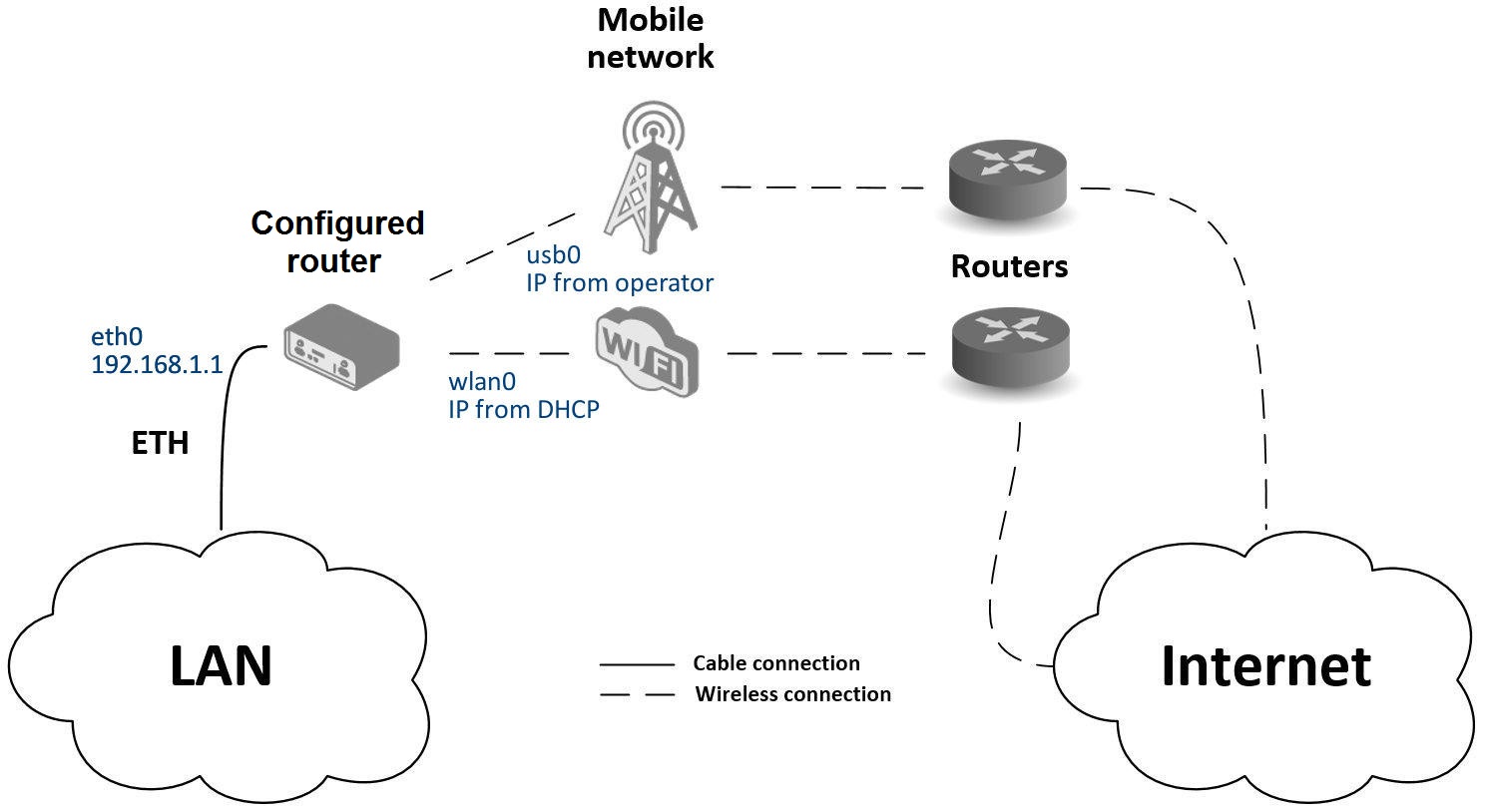
The Backup Routes page lets you back up the primary connection with alternative connections and assign each one a priority.
LAN Configuration
Use the factory default LAN configuration as in the previous use case. Detailed Ethernet configuration is described in the Configuration chapter.
Wi-Fi WAN Configuration
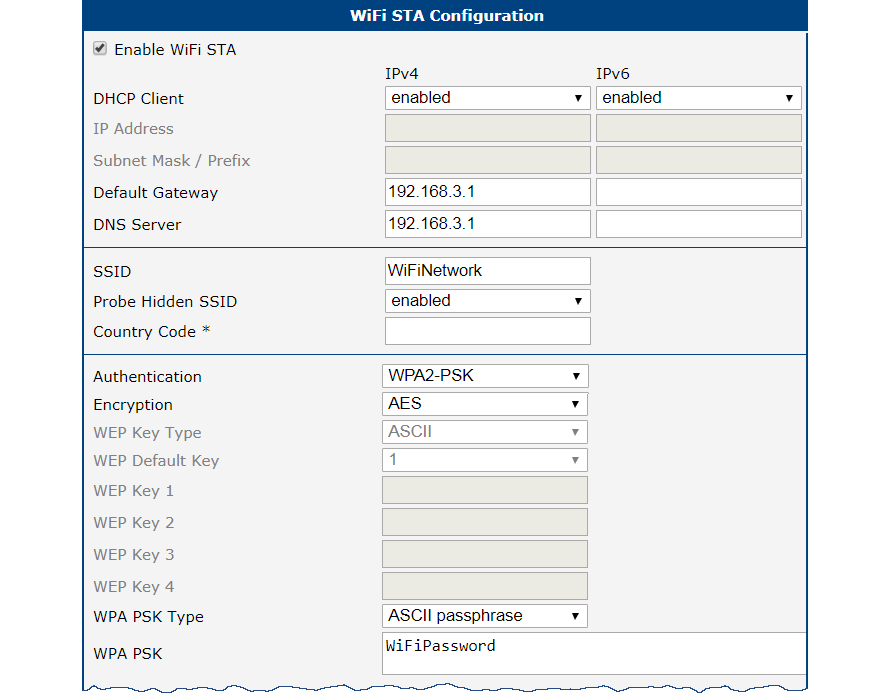
Configure the Wi-Fi station in Configuration → WiFi → Station. Check Enable WiFi STA, enable the DHCP client, and enter the addresses of the default gateway and DNS server. Then fill in the connection data: SSID, authentication, encryption, WPA PSK type, and password. Click Apply to confirm.
To verify the Wi-Fi connection, check the WiFi item in the Status section. A successful connection shows wpa_state=COMPLETED.
Mobile WAN Configuration
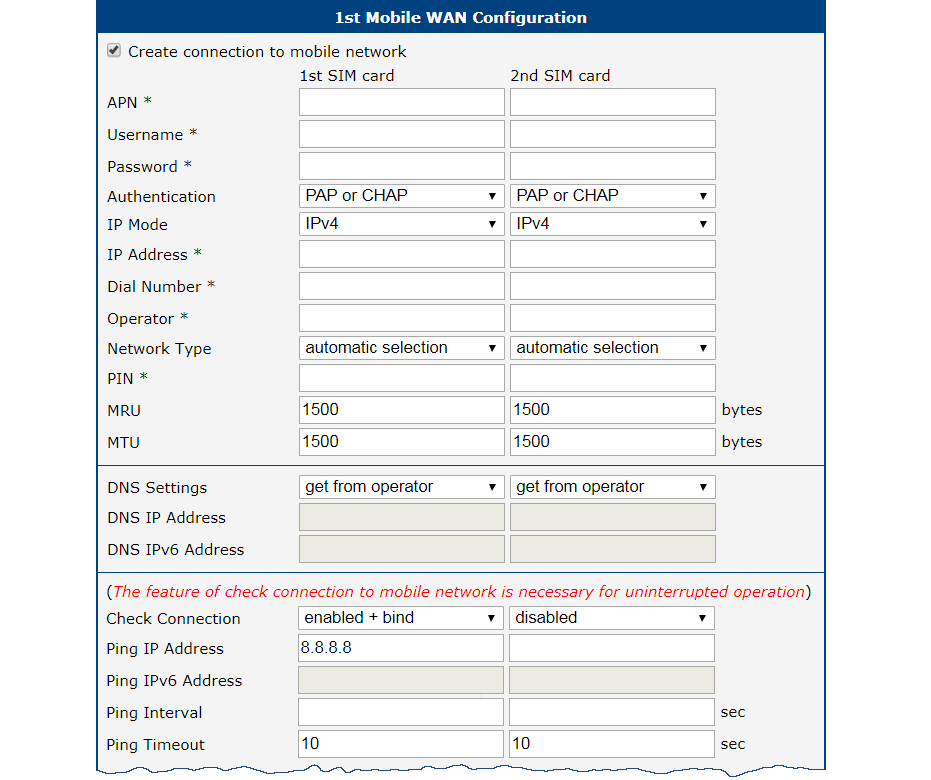
Insert the SIM card into the SIM1 slot and attach the antenna to the ANT connector. To integrate the cellular connection into the backup system, navigate to Configuration → Mobile WAN, set Check connection to enabled + bind, and enter a reliable IP address to ping and the check interval.
Backup Routes Configuration
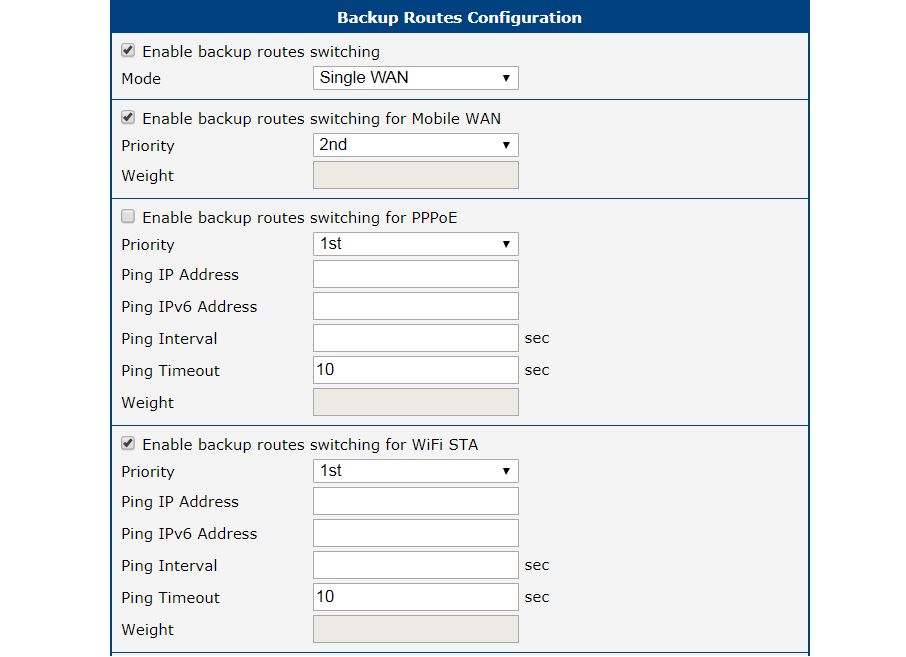
After setting up the backup connections, configure their priorities in Configuration → Backup Routes. In this example, the Wi-Fi connection (wlan0) has the highest priority and the mobile connection (usb0) has the lowest. Enable backup routes switching for each route and click Apply.
You can verify the configured network interfaces in Status → Network. The route table at the bottom of the page shows which interface is currently active as the default route. If the Wi-Fi connection fails, the router automatically switches to the mobile connection.
Tips
Backup routes work even if they are not activated in the Backup Routes item — the router then uses the factory default backup route behavior.
Secure Network Interconnection with VPN
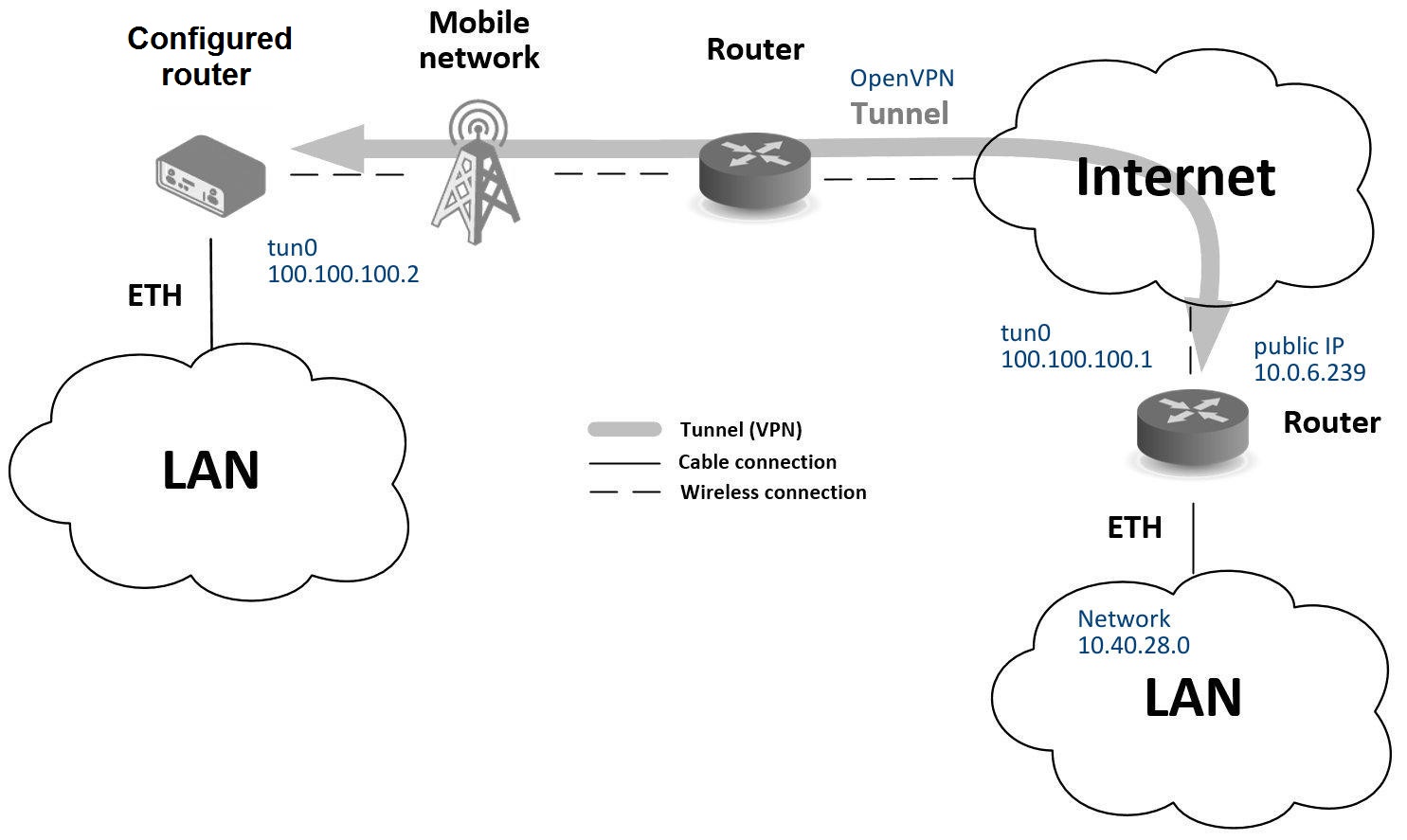
A Virtual Private Network (VPN) creates a secure, encrypted tunnel over an untrusted public network (such as the Internet), allowing two or more separate LANs to communicate as if they were a single private network. This ensures both the confidentiality and integrity of the exchanged data.
Advantech routers support several VPN protocols, including:
- OpenVPN: A highly flexible and secure SSL/TLS-based VPN.
- IPsec: A standards-based framework for securing IP communications.
The router also supports non-encrypted tunneling protocols such as GRE, PPTP, and L2TP, which can be combined with IPsec to create secure VPNs.
This example demonstrates how to establish an OpenVPN tunnel between two routers using a pre-shared secret key for authentication.
Configuration
Mobile WAN Configuration
A stable Internet connection is required before establishing a VPN tunnel. Insert a SIM card and attach the antenna. The router typically establishes a cellular connection automatically. Verify that the mobile connection is active under Configuration → Mobile WAN.
OpenVPN Configuration
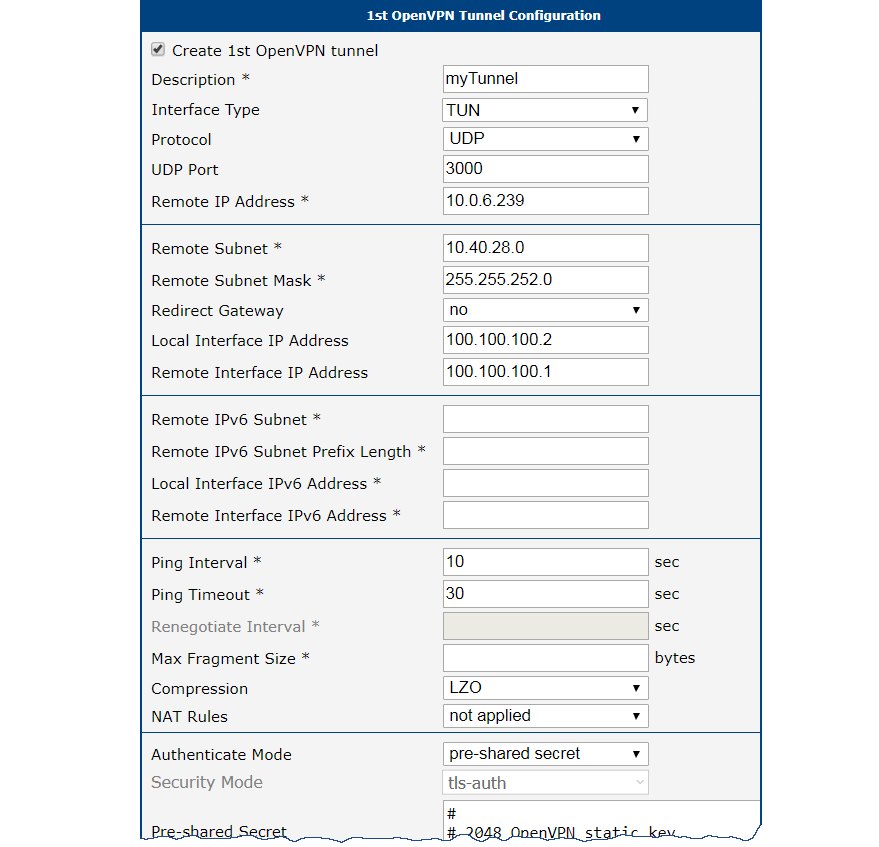
- Navigate to Configuration → OpenVPN.
- Enable one of the available tunnels by checking Create 1st OpenVPN tunnel.
- Set the Protocol and Port to match the settings of the remote router.
- In the Remote Host and Port field, enter the public IP address of the remote router.
- In the Authentication Mode dropdown, select Static key (pre-shared).
- Paste the pre-shared secret key into the Static key field.
- Define the virtual IP addresses for the tunnel endpoints in Local Interface IP Address and Remote Interface IP Address. These must form a mini-subnet for the tunnel (e.g.,
10.8.0.1and10.8.0.2). - Click Apply to save the configuration.
Verifying Connectivity
Confirm that the VPN tunnel is active:
- Network Status: Navigate to Status → Network. A new virtual interface
tun0should be listed with the IP address you configured. - System Log: Navigate to Status → System Log. Look for an
Initialization Sequence Completedentry, confirming the OpenVPN tunnel is established.
Once the tunnel is active, you can verify it by pinging the remote tunnel endpoint's IP address from the router's command-line interface via SSH.
Serial Gateway
The Serial Gateway feature encapsulates serial data into IP packets, enabling communication with serial devices (such as PLCs, meters, or sensors) over an IP network. This creates a virtual serial port across the Internet, allowing a central SCADA system or remote PC to collect data from or control legacy serial equipment.
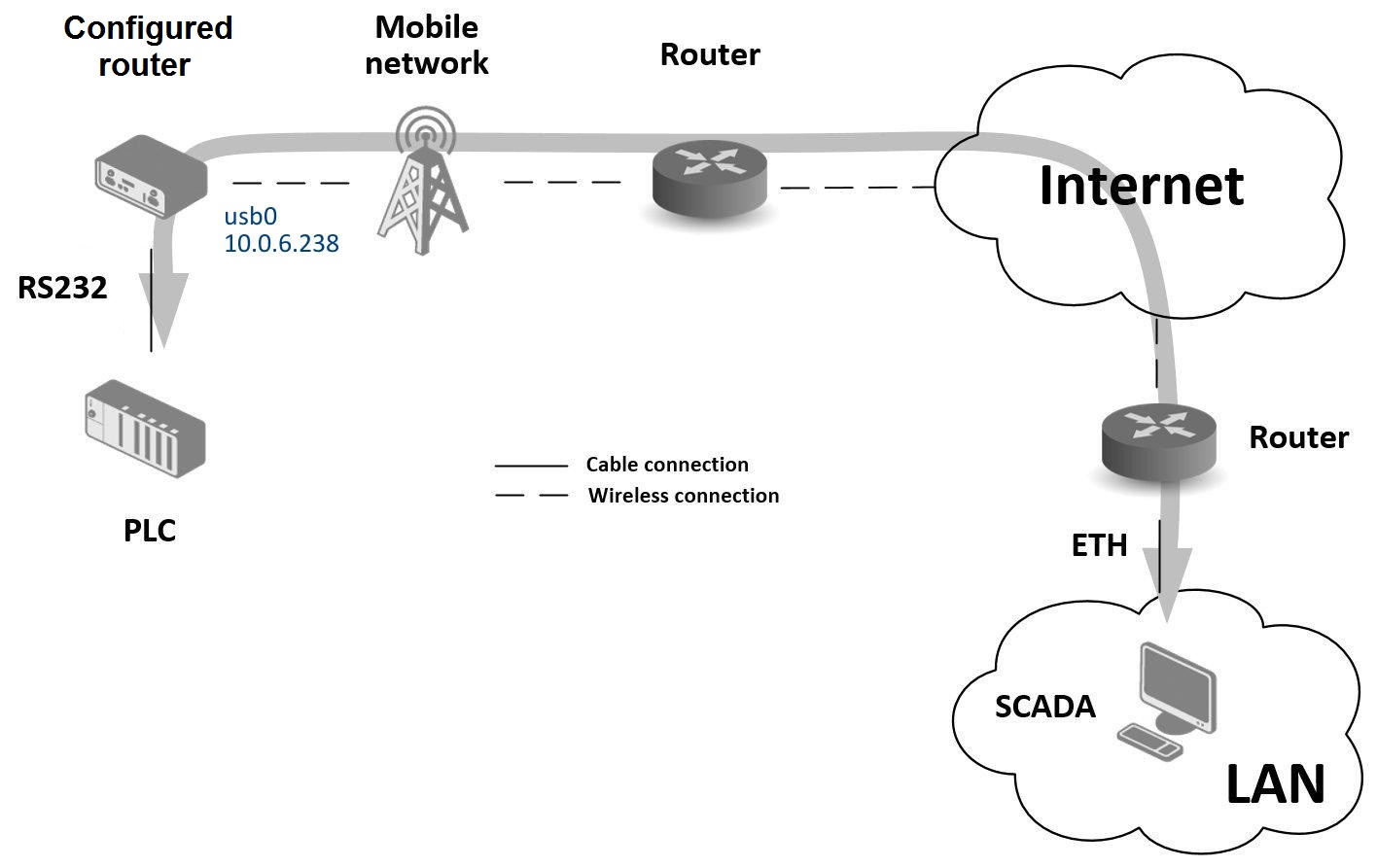
The router's Expansion Port is connected to a PLC, and the router is configured as a TCP server. A remote PC (SCADA) connects as a TCP client to communicate with the PLC.
Mobile WAN Configuration
Mobile WAN configuration is the same as in the previous examples. Insert the SIM card into the SIM1 slot and attach the antenna to the ANT connector. No additional configuration is required. For more details, see the Mobile WAN section in the Configuration chapter.
Expansion Port Configuration
Navigate to Configuration → Expansion Port. Check Enable expansion port 1 access over TCP/UDP. Edit the serial communication parameters if needed. Set Protocol to TCP and Mode to server — the router will listen on the configured TCP port. Click Apply to confirm.
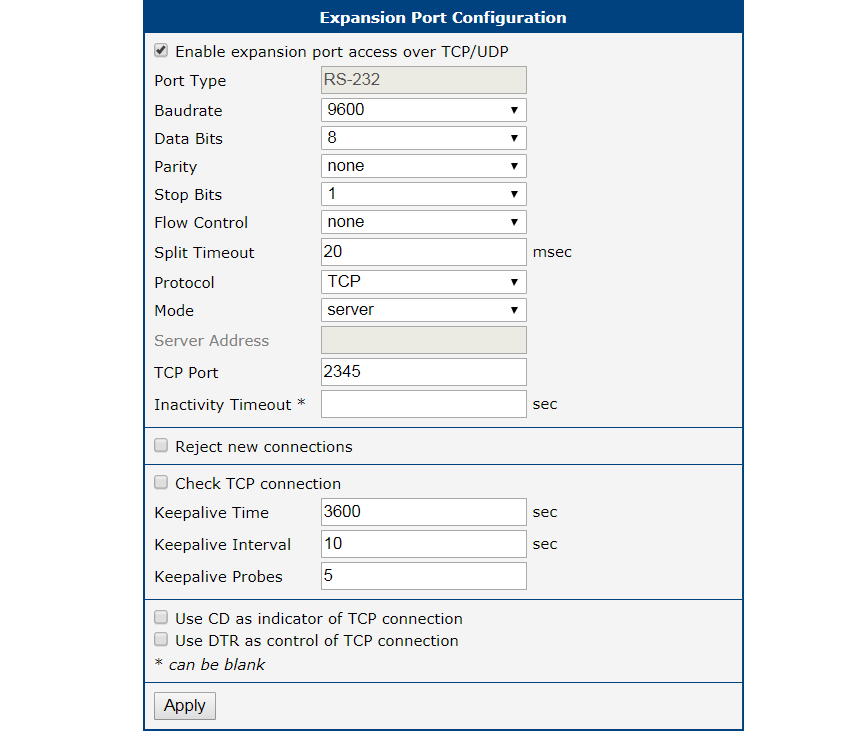
To communicate with the PLC, connect from the remote PC (SCADA) as a TCP client to the router's public IP address (e.g., 10.0.6.238) on the configured port (e.g., 2345). To verify the connection, navigate to Status → System Log and look for the TCP connection established message.